
Model reliability / Feb – Apr 2026
Risk-Adjusted Hallucination Detection
Calibrated abstention for grounded QA
Combines uncertainty and evidence signals to estimate hallucination risk and abstain selectively on high-risk answers.
Architecture & evidence
Architecture
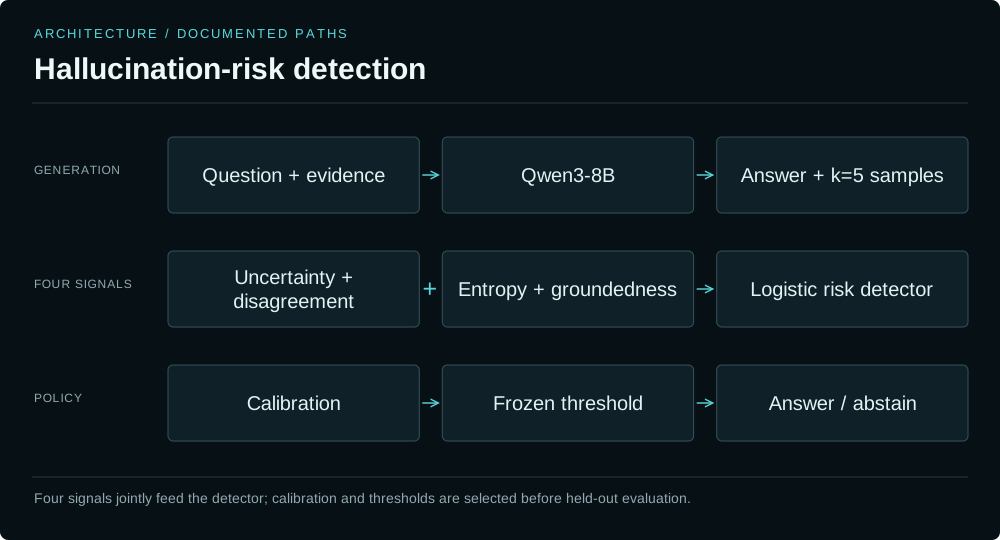
Published research figure
The problem
A grounded-QA system needs a calibrated way to decide when it should answer and when the evidence is too weak.
System architecture
Answer generation feeds uncertainty and evidence feature extraction, detector training, calibration, abstention thresholding, frozen model bundles, and transfer evaluation.
Evaluation
The study uses 4K PHANTOM and 1.3K WikiQA examples, Qwen3-8B generation, Qwen3-14B judging, and k=5 self-consistency sampling.
Robustness limits
Bidirectional transfer experiments diagnose feature-distribution shift, calibration instability, and threshold non-portability between PHANTOM and WikiQA.
What I built
- Built a calibrated hallucination-risk detector using 4 uncertainty/evidence signals: token uncertainty, self-consistency disagreement, semantic entropy, and groundedness consistency.
- Engineered an end-to-end ML pipeline for answer generation, feature extraction, feature-table construction, detector training, calibration, abstention thresholding, frozen model bundles, and transfer evaluation.
- Evaluated on 5.3K grounded QA examples across 4K PHANTOM and 1.3K WikiQA samples using Qwen3-8B generation, Qwen3-14B judging, and k=5 self-consistency sampling.
- Achieved 77.3% AUROC, 64.5% AUPRC, 75.9% accuracy, and 63.7% F1 on PHANTOM hallucination-risk detection.
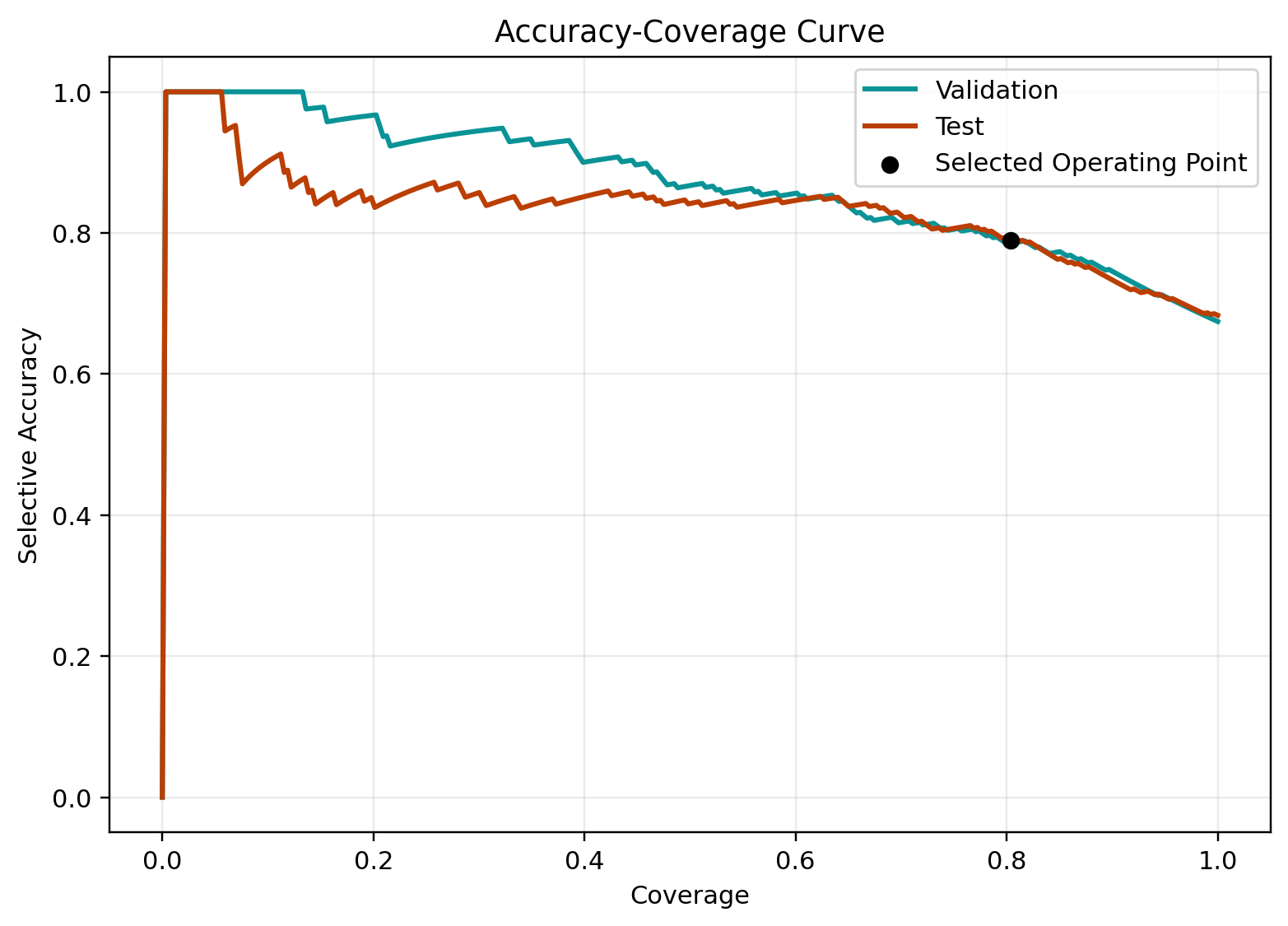
- Improved PHANTOM selective accuracy from 68.3% to 78.6% by abstaining on the riskiest 18.2% of answers while preserving 81.9% coverage.
- Compared Platt scaling, isotonic regression, temperature scaling, and raw probabilities, reaching calibrated test ECE of 0.0734 on PHANTOM and 0.0725 on WikiQA.
- Validated robustness limits through bidirectional transfer experiments, PHANTOM→WikiQA and WikiQA→PHANTOM, diagnosing feature-distribution shift, calibration instability, and threshold non-portability.
Explore the implementation
Source code, setup instructions, and project documentation are available in the repository.