
Agentic systems / Sep 2026
FactorForge
Agentic quantitative research & backtesting
Turns investment ideas into literature searches, hypotheses, factor strategies, controlled backtests, and inspectable experiment lineage.
Architecture & evidence
Architecture
Repository walkthrough
The problem
Quantitative research needs more than generated strategies: it needs controlled execution, cost-aware validation, and a record of successful and failed experiments.
System architecture
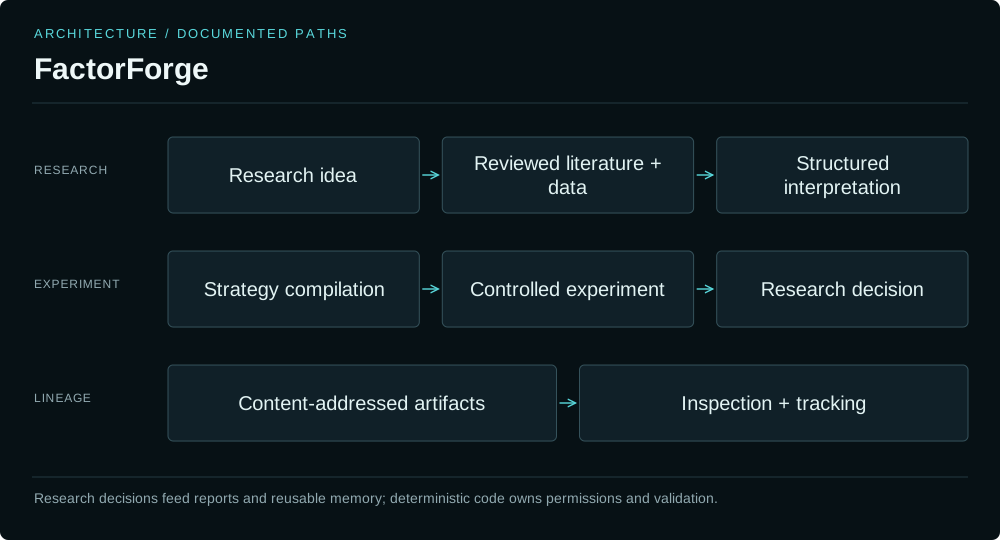
Natural-language investment ideas become literature, hypotheses, hybrid factor strategies, sandboxed backtests, and iterative decisions through a deterministic execution engine.
Evaluation
Validation combines multi-paper synthesis, walk-forward and purged splits, transaction-cost modeling, and statistical robustness checks across 15 price-based signals and three cost settings.
Execution evidence
A reference backtest matches independent LEAN execution across 40+ portfolio valuations and 15+ trade fills, including fees. Research trajectories preserve prompts, data, code, and backtest lineage.
What I built
- Built an autonomous quantitative-research system that turned natural-language investment ideas into relevant literature, structured hypotheses, hybrid factor strategies, sandboxed backtests, and iterative research decisions, backed by a deterministic execution engine exercised across 45 historical signal-and-cost cases covering 30,000+ historical data records.
- Developed a validation pipeline with multi-paper synthesis, walk-forward and purged validation splits, transaction-cost modeling, and statistical robustness checks to evaluate published-factor reproduction and factor-spec extraction accuracy across 15 price-based signals across 3 cost settings achieving 100% agreement across 40+ portfolio valuations and 15+ trade fills—including fees against independent LEAN execution of a reference backtest.
- Recorded successful and failed experiments as reusable research memory and training trajectories, preserving 100% of prompts, datasets, code, backtests, and experiment lineage, verifying linked research artifacts, tracing 1,200+ agent/tool spans, and reducing average research runtime from 46 min to 18 min at $0.84 average LLM cost per research run.
Explore the implementation
Source code, setup instructions, and project documentation are available in the repository.